Journal
Fruit Tree Sadaqah Jariyah: The Complete Guide
A fruit tree sadaqah jariyah, explained: the hadith, the nine species and their prices, what proof you receive, and how to plant one for a named family.
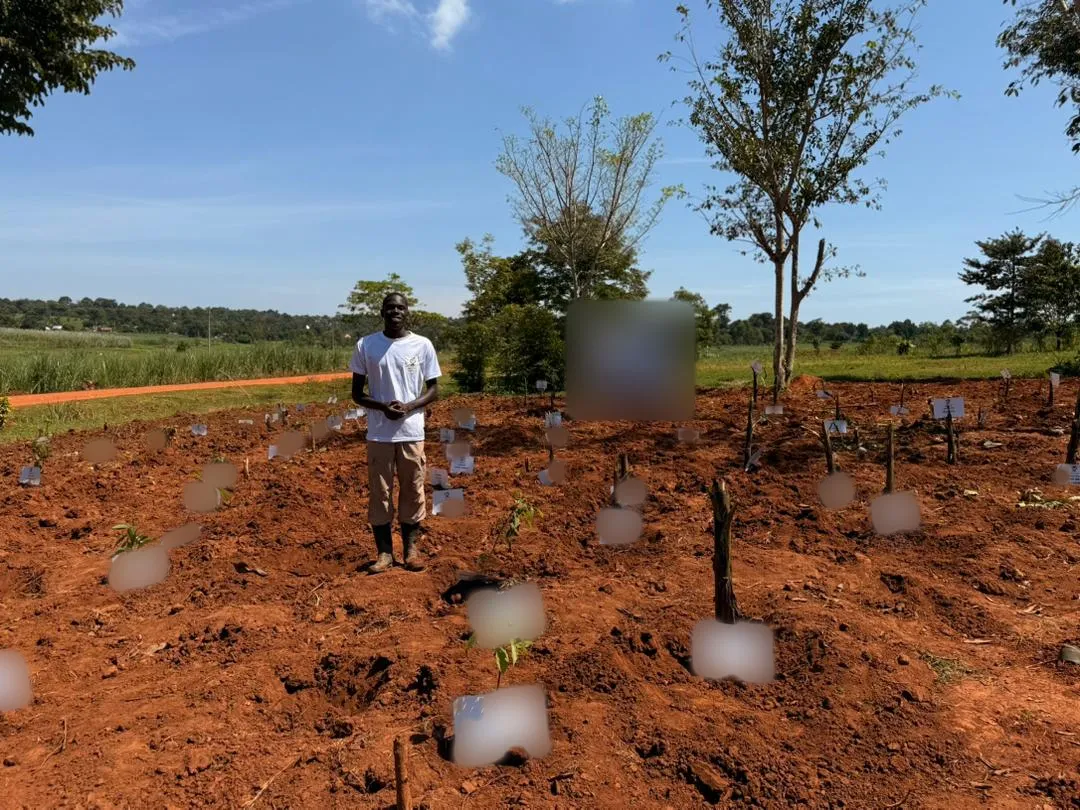
A fruit tree sadaqah jariyah is a fruit tree planted as a continuing charity: for as long as people, birds or animals eat from it, the Prophet ﷺ described it as charity for the one who planted it. With Blue & Green Hope you plant one for a named family, from £39, with photos and the GPS location as proof.
Fruit trees are one of the simplest forms of continuing charity to understand. You can see the tree, you can name it, and the family who receives it can eat from it, share it and sell what they do not need. That is very different from a gift that is spent once and then gone.
This guide brings everything together in one place: what the hadith says, how the nine species compare, what each one costs, what you receive as proof, and how trees combine with wells and monthly giving. Each section links to a fuller article if you want to go deeper.
Is planting a fruit tree sadaqah jariyah?
Yes, according to a well known hadith. The Prophet ﷺ said that whatever a person, a bird or an animal eats from a tree someone planted is counted as charity for that person. Scholars cite this narration when they describe tree planting as a form of continuing charity.
No Muslim plants a tree or sows a crop from which a bird, a person or an animal eats, except that it is counted as charity for him.Sahih al-Bukhari, no. 2320
A second narration, reported by al-Bazzar and authenticated by al-Albani in Sahih al-Targhib, no. 73, lists seven deeds whose reward reaches a person in the grave. Planting a palm tree is one of them, alongside digging a well and teaching knowledge. This is why the date palm holds a particular place for many families.
We never promise a reward. The reward belongs to Allah alone. What we can promise is the work itself: a real tree, planted for a real family, with proof you can check.
Why a fruit tree, and not just any tree?
A tree that gives fruit gives twice. It provides shade and holds the soil like any tree, and it also feeds a household. Fruit the family does not eat can be sold, so the tree becomes a small, steady source of income.
That is the reason we plant fruit trees for named families rather than in anonymous plantations. The family owns the tree and its fruit. They have every reason to look after it, and you know exactly who it serves. Our article on how fruit trees support a family's income explains this in practical terms.
It also changes how the gift feels for you. Instead of a line on a statement, you have a photo of a young tree in the ground, a sign carrying the name you chose, and a point on a map. Many people plant in their own name. Many others plant in memory of a parent or grandparent, which the hadith in Sahih Muslim, no. 1631, speaks to directly.
When a person dies, their deeds come to an end except three: a continuing charity, knowledge that benefits, or a righteous child who prays for them.Sahih Muslim, no. 1631
How do the nine fruit tree species compare?
We plant nine species, chosen because families value them and they suit the land where we plant. Here they are by price:
- Date palm, £109: the palm named in the narration of Sahih al-Targhib. Read the date palm sadaqah jariyah guide.
- Avocado, £65: a valued fruit often sold at market. See planting an avocado tree as sadaqah.
- Jackfruit, £65: a large tree with very large fruit, compared in citrus, avocado and jackfruit trees side by side.
- Mango, £46: widely loved and familiar. Our mango tree sadaqah jariyah article covers it in full.
- Lemon and orange, £46 each: useful in the kitchen and easy to sell. See lemon and orange trees as sadaqah.
- Banana, guava and papaya, £39 each: the quicker trees, explained in fast fruiting papaya, banana and guava trees.
If you are unsure, our guide to choosing a fruit tree for sadaqah matches species to goals and budgets.
How much does a sadaqah jariyah tree cost?
Prices run from £39 to £109 per tree, depending on the species. The price covers the young tree, its planting for a named family, the sign with your chosen name and the proof sent to you by email. For readers outside the UK, prices are shown in your own currency on the site.
Volume discounts are real and applied at payment: two trees are 10% off and three or more are 20% off. So three mango trees, which would be £138 at full price, come to £111. There is no hidden fee and nothing added at checkout.
We explain every line of the price in our breakdown of what a fruit tree donation costs and why. You can also see all species and prices on the fruit trees page.
What proof do you receive for your tree?
Proof is the centre of what we do. For every tree, you receive:
- Photos of the planting itself, not a library image
- A photo of the sign carrying the name you chose
- The exact GPS location, so you can find the spot on a map
- Everything by email, as a permanent gallery link you can keep and share
We describe the full sequence, from choosing the site to the photos you receive, in how a fruit tree is planted, step by step. We do not publish figures we cannot yet audit, and we will not attach invented numbers to your tree.
Who receives the trees, and how are families chosen?
Each tree is planted for a named family, who then owns it and its fruit. The field teams we work with have planted more than 60,000 fruit trees and helped more than 30,000 families, so the process of choosing and preparing households is well established.
Families are chosen for need and for their ability to look after a tree on their own land. The tree is theirs, not ours. Our article on fruit trees for families in Uganda gives more background on who the families are and how the planting is organised with them.
Can you combine trees with a well or an orchard?
Yes. Water and fruit trees work together naturally: a family with a reliable source of water nearby is in a far better position to keep young trees healthy. Our article on pairing a water well with fruit trees explains how a combined gift works.
Packs let you give several items in one payment under one name. You can choose a well with fruit trees, or an orchard of 10 or 50 trees. The family orchard sadaqah jariyah guide covers larger plantings, including orchards given by a whole family together.
If you prefer to give regularly, monthly gifts start at £15 with The Seed, and you can change or stop at any time with one email.
Guides in this series
Each of these articles answers one question in depth. Together they form the full picture of fruit tree sadaqah jariyah.
- Planting a fruit tree online, start to finish
- Fruit tree prices by species
- Which species suits your intention
- The date palm as a continuing charity
- Planting a mango tree for a family
- The avocado tree donation
- Citrus trees: lemon and orange
- Comparing jackfruit, avocado and citrus
- Quick fruit trees: papaya, banana, guava
- How each tree is planted
- The families who receive the trees
- What a fruit tree means for a household
- Giving a whole family orchard
- A well and trees as one gift
Questions people ask
Can I plant a fruit tree on behalf of someone who has died?
Yes. In Sahih al-Bukhari, no. 1388, a man asked the Prophet ﷺ whether he could give charity on behalf of his late mother, and the Prophet ﷺ said yes. You can put their name on the sign, and the proof is sent to you by email to keep or share with family.
What name appears on the sign?
The name you choose at checkout. It can be your own name, a family name, or the name of someone you are planting for. The sign is photographed in place and the photo is included in your gallery, so you can see exactly how it reads.
Is Blue & Green Hope a charity?
No. Blue & Green Hope is a UK company, not a charity. We say this plainly so you know what you are giving to. We publish what each gift pays for, and we send proof of every tree and every well.
Can I give a tree as a gift to someone else?
Yes. Many people plant a tree in the name of a friend, a child or a newly married couple. You choose the name for the sign, and you can forward the gallery link from the email so they can see the planting photos and the location themselves.
Do I have to plant more than one tree?
No. One tree is welcome and receives the same proof as a larger order. If you do plant two, the 10% discount applies automatically, and from three trees the 20% discount applies to the whole order.
Where to start
If you already know which species you want, go straight to it. If not, a mango or a date palm is a natural first choice, and three trees bring the 20% discount. Whatever you choose, you will see where it stands. When you are ready, you can plant a fruit tree for a named family.
Keep reading
Plant a Tree Online: How a Fruit Tree Sadaqah Works
How to plant a tree online as sadaqah jariyah: choose a species, add a name for the sign, pay once, and receive planting photos and the GPS location.
Best Times to Give Sadaqah: A Year-Round Islamic Calendar
The best times to give sadaqah across the Islamic year, from Ramadan 2027 to Dhul Hijjah and family milestones, with a calm plan for sadaqah jariyah.
Water Well Donation Proof: The Complete Guide for Donors
Water well donation proof explained: the photos, video, GPS location and handover report you should receive, and how to check each one yourself.